One Platform, Every Table: Why Your Reservation Tool Is Leaving Money on the Table
From a regular dinner for two to an exclusive Chef's Table at €200 — discover why top restaurants manage it all in one place instead of juggling multiple tools.

One Platform, Every Table: Why Your Reservation Tool Is Leaving Money on the Table
Most restaurant reservation tools were built with a single scenario in mind: a guest picks a date, picks a time, picks a table size, and confirms. Clean, simple, done.
But a modern full-service restaurant isn't a single scenario. It's a dozen different ones happening simultaneously — and each one has completely different needs.
The Multi-Speed Restaurant Reality
Think about what a typical Friday night looks like at a serious restaurant:
- A couple books a regular table for two at 7pm — quick, frictionless, no payment needed
- A party of six reserves the private dining room for a birthday — they need a deposit and a custom menu
- Four guests book the once-a-month Chef's Table at €200 per person — fully prepaid, exclusive, non-refundable
- A group signs up for the weekend wine tasting — ticketed, limited to 12 guests, meal selection required in advance
These four bookings need completely different rules. Different payment flows. Different cancellation terms. Different communication. Different check-in procedures.
A basic calendar widget handles exactly one of them well. The other three get shoehorned into the same rigid structure — or handled manually via phone calls, WhatsApp messages, and spreadsheets.
The Hidden Cost of Running Multiple Tools
Most restaurants that have evolved beyond basic table booking end up with a patchwork:
- A calendar tool for regular reservations
- A ticketing platform (Eventbrite, pretix) for wine dinners and special events
- A payment link or invoice for private dining deposits
- A WhatsApp group or email thread to coordinate everything
This isn't just inefficient. It's costly in every direction:
- Guest data is fragmented across three platforms — you can never build a unified guest profile
- No-shows aren't protected on the basic calendar bookings
- Every tool takes a cut — commissions, platform fees, and transaction fees stack up fast
- Your team constantly switches context — from one dashboard to another
And worst of all: your most valuable offerings — the ones that define your restaurant's identity — get the worst booking experience.
One Configuration Per Experience, Not One Size for All
Gustaio was built on a different premise entirely: every offering in your portfolio deserves its own rules.
A regular weeknight dinner, a weekend brunch, an exclusive Chef's Table, a private event for twelve — each one is set up as its own Experience, with its own payment logic, its own cancellation terms, its own communication flow. None of them interfere with each other. None of them require a workaround.
The restaurant doesn't need five tools. They need one — and it adapts to whatever they serve.
What This Looks Like in Practice
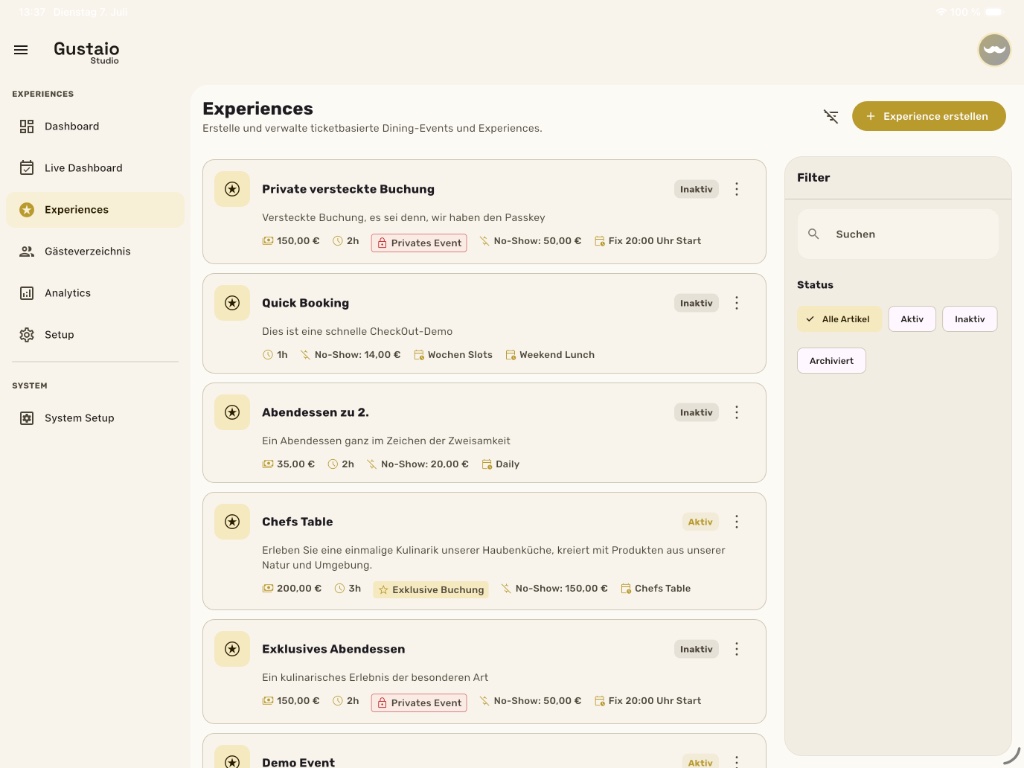
From the restaurant's side (Gustaio Studio), the Experiences overview shows every offering at a glance: the Chef's Table with its gold "Exclusive Booking" badge at €200, the everyday dinner option at €35, the private event with its lock icon, the quick-booking flow for standard tables. Each row shows the price, the no-show fee, the slot type — everything the team needs to manage the full portfolio in one view.
From the guest's side, the booking app presents a beautiful, curated experience: stunning food photography, clear pricing, and a smooth checkout flow tailored to whatever they've selected. Booking a Chef's Table feels like booking a Chef's Table — not like filling out a generic form.
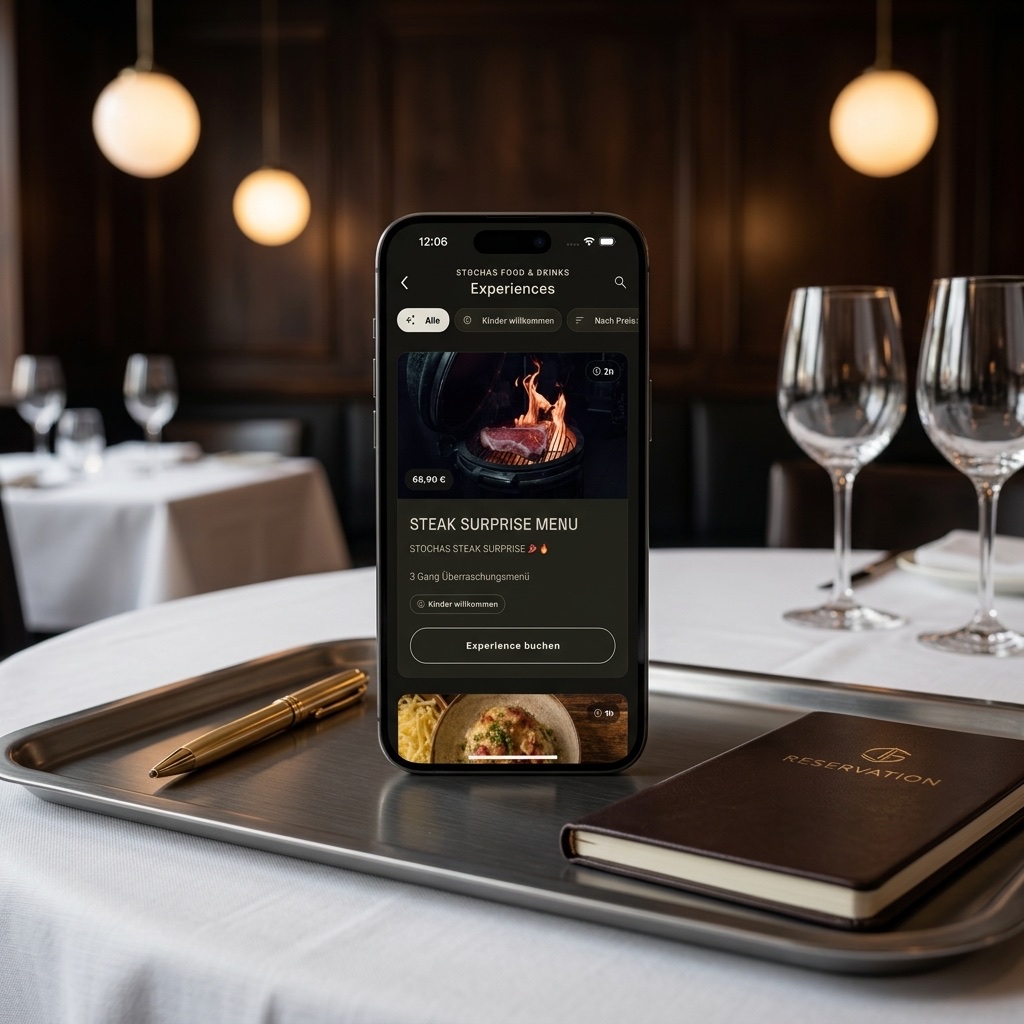
Both sides live in the same platform, connected automatically.
No More "That's Not What Our Tool Does"
The moment someone on your team says "we can't do that in our booking system, we'll handle it manually" — that's money leaving through the back door.
Manual coordination means:
- Deposits collected informally (and sometimes forgotten)
- No-show fees not enforced because the booking was non-binding
- Guest preferences lost between platforms
- Zero historical data on your most valuable guests
Gustaio closes all of these gaps. Setting up a new Experience is fast, and once it's live, the system handles payment, communication, and no-show protection without anyone on your team lifting a finger.
Your team focuses on hospitality. The platform handles the rest.
The Real Differentiator
The restaurant industry's reservation tools haven't fundamentally changed in 15 years. They made calendars slightly prettier and added online payment. But the underlying logic — one type of booking, one set of rules for everyone — remains unchanged.
The restaurants winning right now aren't the ones with the most covers. They're the ones with the highest revenue per cover, the strongest guest relationships, and the ability to create experiences that can't be booked anywhere else.
That requires a platform that thinks in experiences — not just tables.
Gustaio handles everything from the walk-in to the Chef's Table, in the same app, on the same dashboard, with the same guest profile.
Ready to See It in Action?
Create your first Experience in under 10 minutes and start managing your entire portfolio — regular bookings, premium experiences, and everything in between — without switching tools.
No commissions. No setup fees. Full brand control.


